


Authorisation Optimisation Is Payments' Next Big Lever
How smarter authorisation - not just stronger fraud rules - is becoming the difference between revenue captured and revenue quietly lost
For years, the payments industry measured success at checkout by a single number: the fraud rate. Keep it low, and the system was working. But that lens misses a far larger problem hiding in plain sight — one that costs businesses more than fraud itself.
It’s called the false decline: a legitimate transaction, from a legitimate customer, rejected by mistake.
A Bigger Problem Than Fraud
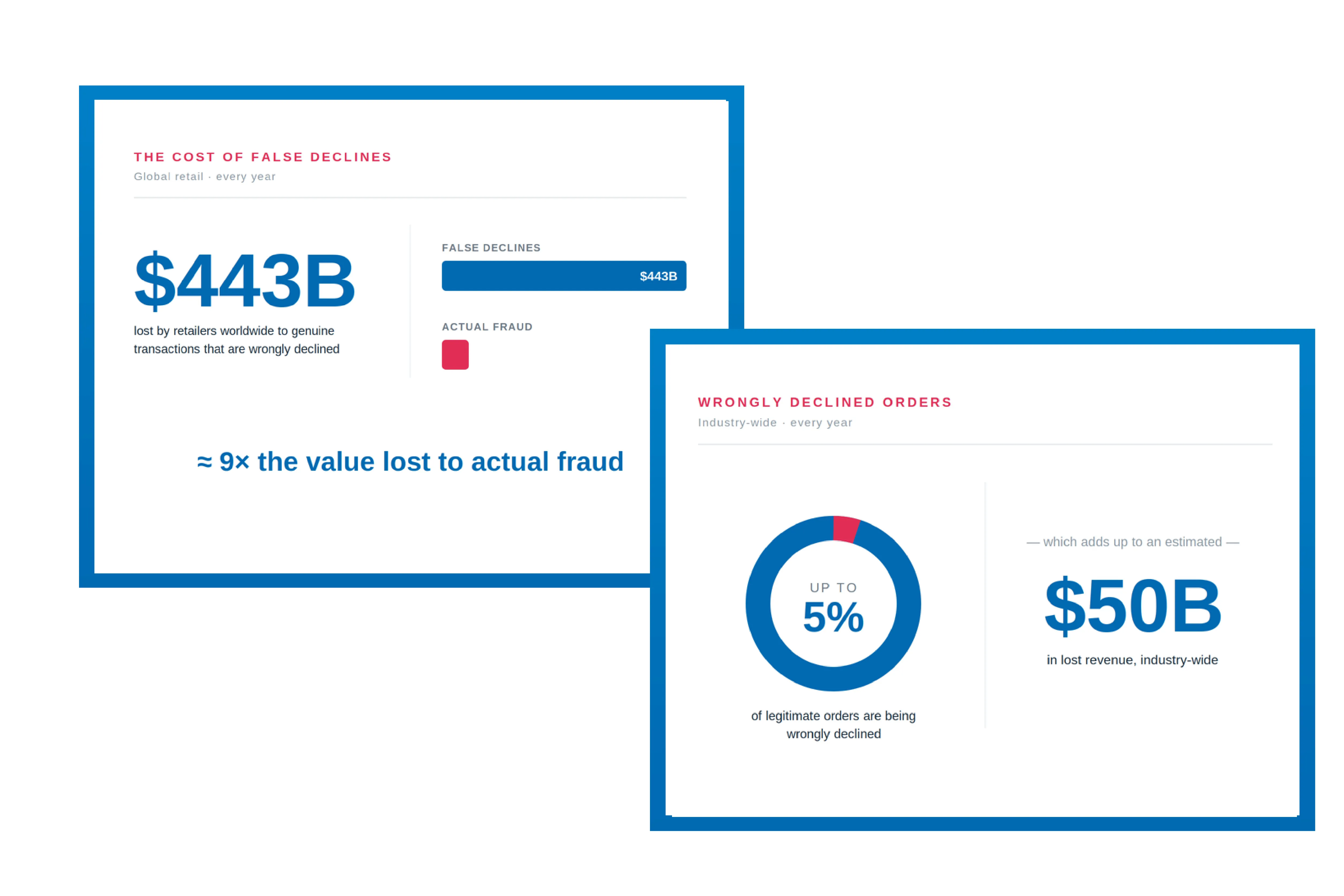
Recent industry research puts the scale of this in perspective. Riskified estimates false declines cost retailers roughly $443 billion a year globally — about nine times the value lost to actual fraud. PYMNTS reporting in early 2026 found that nearly half of merchants believe up to 5% of legitimate orders are being wrongly declined, adding up to an estimated $50 billion in lost revenue industry-wide. And the customers most often caught in the crossfire — travellers, expats, first-time shoppers, anyone whose behavior doesn’t fit a narrow historical pattern — are frequently a business’s most valuable ones.
Every wrongly declined transaction is a double loss: the sale itself, and often the customer relationship that goes with it. Industry studies suggest a meaningful share of shoppers who hit a false decline simply don’t come back.
This is the problem authorisation optimisation exists to solve — not by loosening fraud controls, but by making the entire authorisation journey smarter, from the moment a card is presented to the moment a transaction either clears or fails.
Rules first, intelligence layered on
Clear, well-governed rules based on known network and issuer behaviour can deliver measurable gains quickly. Decline analytics is especially valuable when implemented early, because the insights it produces help shape the next wave of optimisation.
AI then builds on that foundation, not as a substitute but as the next stage of maturity. Capabilities such as ML-based retry timing, adaptive risk scoring, and self-tuning routing improve as more data and transaction history become available. Rules and AI are not competing models; they are successive steps on the same journey. With the right architecture, businesses can move from one to the other without redesigning checkout or requiring merchants to integrate twice

Every wrongly declined transaction is a double loss: the sale itself, and often the customer relationship that goes with it.
Why this matters now, especially in MEA
Authorisation optimisation is a global conversation, but it has particular weight in fast-growing, diverse markets like the Middle East and Africa. High volumes of cross-border and tourist spend, a wide mix of local and international card schemes, and rapidly digitizing merchant ecosystems all create more authorisation complexity — and more opportunity — than a single-market, single-scheme environment.
For issuers and acquirers operating across multiple markets and currencies, the businesses that treat authorisation as a strategic, continuously optimised system — rather than a fixed cost of doing payments — are the ones that will capture transaction volume their competitors quietly lose.
The Bottom Line
Fraud prevention will always matter. But in 2026, the more interesting question for any payments business isn’t only “how do we stop bad transactions?” It’s “how many good transactions are we accidentally stopping — and what would it take to get them back?”
That question is where authorisation optimisation starts.
Next read
Why payment resilience is now essential to keeping digital economies running smoothly and securely
